
Crevano · Templates · Printable Ticket Templates
Printable Ticket Templates
6 sheets of tickets you print, number, cut and tear. Raffle tickets with matched stubs, event admission, concert tickets with a seat block, fundraiser dinner tickets that collect a meal choice, small carnival tickets that are spent rather than matched, and lanyard passes.
The thing that makes a ticket a ticket is on all of them: the same number is printed on the body and on the stub, because the half in the drum has to be findable from the half in somebody's pocket.
| Trim size | 8.5 × 11 in |
|---|---|
| Bleed | none |
| Resolution target | 300 DPI |
| Templates | 6 |
| Pages | 6 |
No templates match that.
Ticket templates (6)
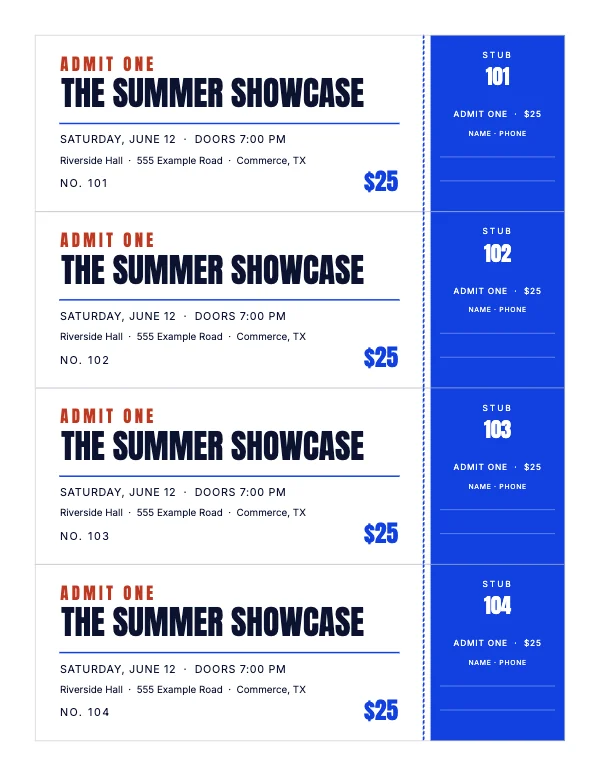 Event Admission Tickets
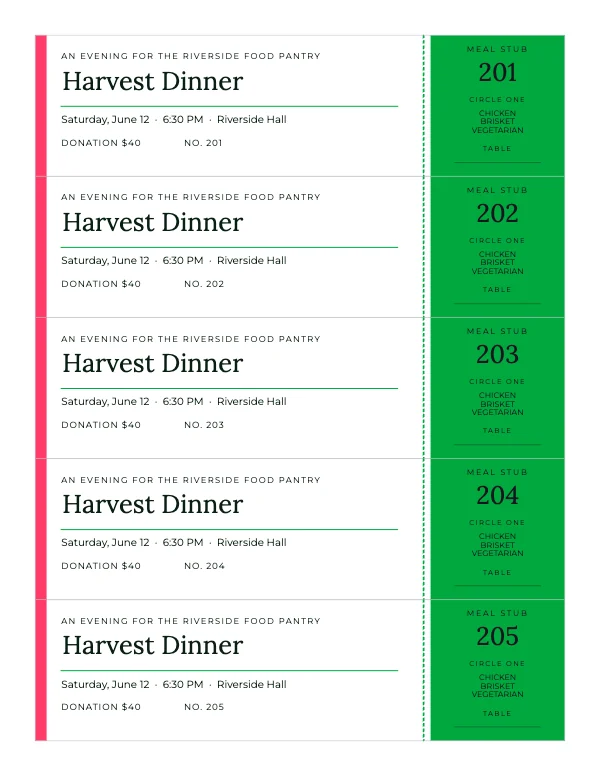 Fundraiser Dinner Tickets
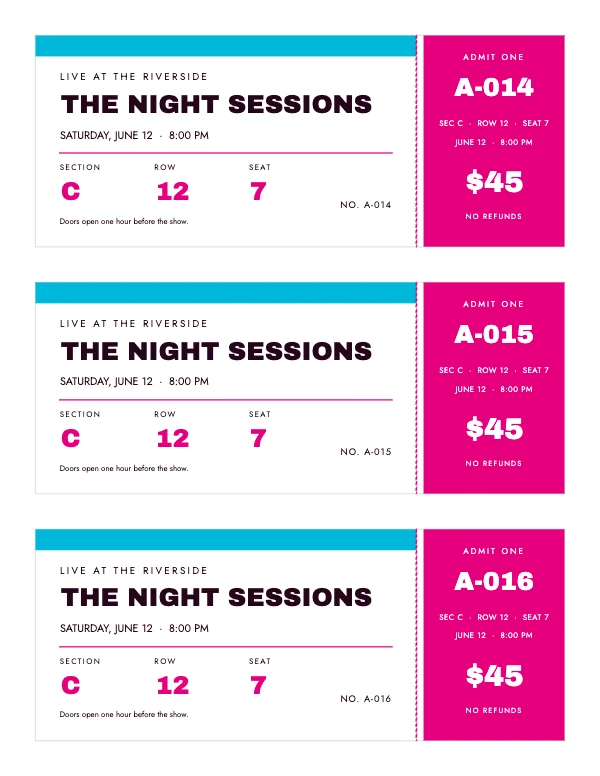 Concert Tickets
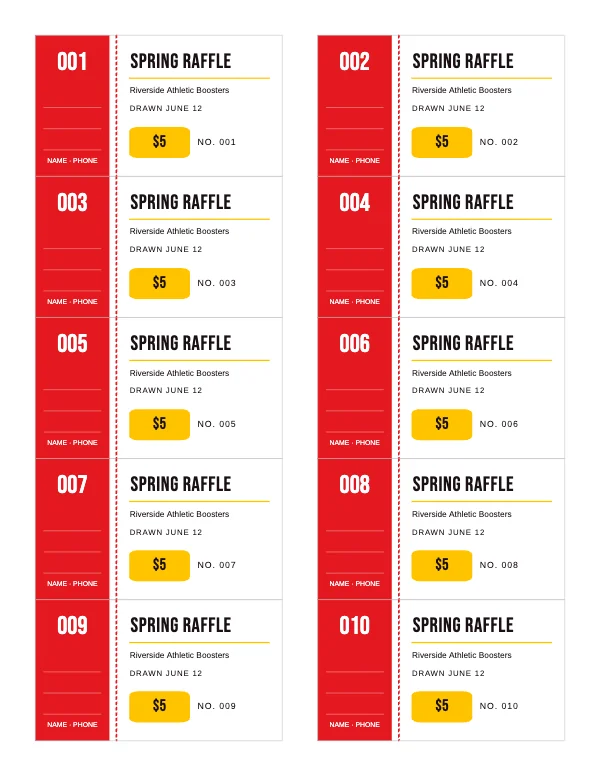 Raffle TicketsPro
 Lanyard Event PassesPro
 Carnival and Activity Tickets
What is free here, and what is not
4 of these 6 templates are on the free plan: Blue and Flame 8.5 × 11 in Event Admission Tickets, Yellow and Blue 8.5 × 11 in Carnival and Activity Tickets, Magenta and Cyan 8.5 × 11 in Concert Tickets, Green and Pink 8.5 × 11 in Fundraiser Dinner Tickets. The other 2 carry a badge in the corner of the thumbnail and will be on the paid plan.
Crevano is a paid design app with a free basic tier. Opening the studio and designing in it costs nothing beyond a free account — your own photographs, the element library, screen exports as PNG or JPG, cloud saving, and a project file you can keep on your own device — and there is no watermark on anything you export, on any plan, ever. The paid plan will be the rest of the template library, the print PDF with bleed and crop marks, and the KDP export; it is not open for sign-ups yet, so nothing here is withheld in the meantime.
On either plan, what you make is yours to publish and sell. No royalty, no credit, the permission does not expire, and it still holds if you cancel. What you may not do is resell our photographs and clip art as things in themselves.
The number is the product
A raffle ticket that is not numbered is a piece of paper. The number is the entire mechanism: you keep one half, the buyer keeps the other, and at the draw the two halves have to identify each other.
Every ticket on these sheets carries its number twice — once on the body, once on the stub — and the numerals are set at the 0.25 inch cap height the ticket trade prints them at, which is larger than a designer would choose and is the right size for a number read from a bucket in a crowded room by someone standing up.
The numbers are separate text elements, so a second batch is a retype rather than a redesign. If you print more than one sheet, change the numbers between sheets — the sheet prints ten identical copies of itself otherwise, and ten tickets numbered 41 make the draw impossible to settle.
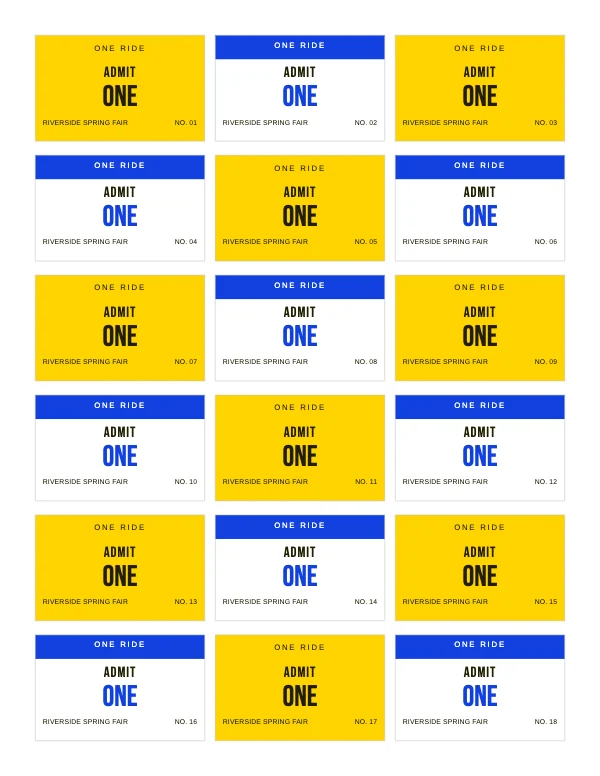
The carnival sheet is the exception, and deliberately: it has no stub, because a spent ticket has nothing to match against. It is handed over at a ride and dropped in a bucket, so the value and the number sit on the one piece.
The perforation is drawn in the ticket's ink, not in gray
This is the difference between a ticket sheet and a sheet with a cut line on it, and it is worth being explicit about because the two look similar in a thumbnail.
A cut line is an instruction to whoever is holding the scissors. It is drawn in gray, it is not part of the design, and it is deleted before printing on a professional job.
A tear line is part of the product. The little dashed rule between a ticket and its stub is printed, and it stays printed, because it tells the person tearing where to tear. So on these sheets it is drawn in the ticket's own ink rather than in the gray of a cut mark — it is artwork, not an instruction, and it is meant to survive.
The lines that separate one ticket from the next are the other kind, and they are gray.
No bleed, because a home printer cannot reach the edge
Every ticket sheet here is built with no bleed at all, and that is a decision rather than an omission.
Bleed exists so a commercial blade has somewhere to be wrong. Neither the blade nor the oversized sheet exists here: these are designed to come out of a home or office printer on plain stock, and a consumer printer holds an unprintable margin on all four sides no matter what you send it.
Send it a page with bleed and the driver scales the whole sheet down to fit its own margin. Everything moves — including the cut lines you were about to trust — which is worse than having no lines at all.
There is a second, quieter consequence: the tickets do not run to the edge of the sheet. The admission ticket body is 7.5 inches rather than the trade's 8.0 for exactly this reason. The trade prints on a press that reaches the paper's edge; your printer does not.
Which sheet is the one you want
| You are | Use | Why |
|---|---|---|
| Selling raffle tickets | Raffle, 10 up | The smallest ticket with a stub. Ten to a sheet, two ruled lines on each stub for a name and a phone number |
| Taking admission at a door | Admission, 4 up | 5.5 in body, the standard event ticket length, with a 2 in tear-off stub |
| Seating people | Concert, 3 up | Section, row and seat as three separate text elements, so they retype one at a time |
| Running a seated fundraiser | Dinner, 5 up | The stub carries the entree choice and the table number rather than a price — that is what the kitchen counts |
| Running games or rides | Carnival, 18 up | Small, no stub, spent rather than matched |
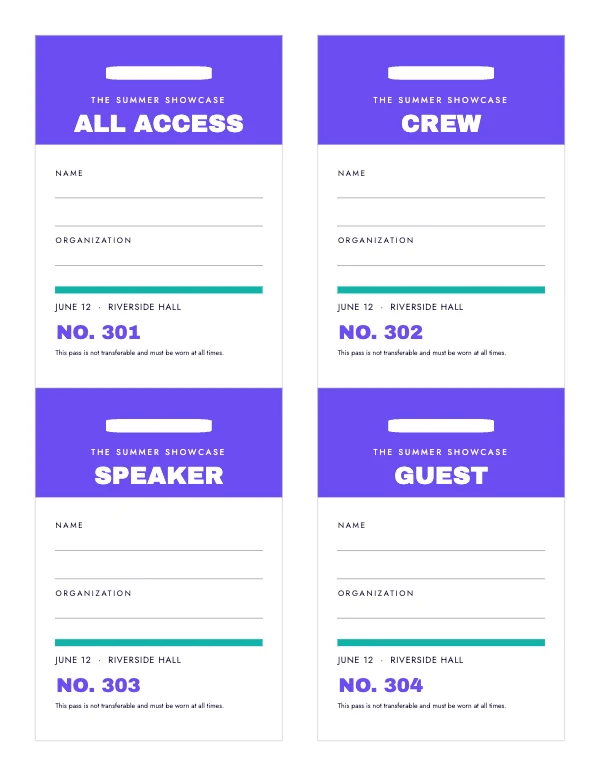
| Badging staff or volunteers | Lanyard pass, 4 up | 3.5 × 5 in with a real 1.5 × 0.19 in slot drawn 0.44 in below the top edge, and nothing allowed inside it |
If you are unsure and it is a fundraiser: raffle for the draw, dinner for the meal. Most events that have one have the other.
Paper, and why it matters more than it looks
Tickets are handled — folded into a pocket, pulled out damp, dropped into a bucket and shuffled against a hundred others. Plain 20 lb copy paper survives none of that well.
65 lb cardstock or heavier is the right answer for anything with a stub, because the tear needs something to tear against. A ticket on thin paper tears crooked or tears through the number, and a torn number is a ticket that cannot be matched.
Feed cardstock one sheet at a time, and use the rear or straight-through tray if the printer has one. A heavy sheet through a curved paper path comes out bowed, and a bowed sheet cuts crooked.
The carnival sheet is the one case where plain paper is fine — those tickets are spent within the hour and nobody keeps them.
Cutting a sheet of tickets
A guillotine trimmer or a rotary trimmer will do a sheet in a few passes and will do it straighter than scissors, which matters because the eye reads a stack of tickets by its edges.
Cut the long straight lines first, all the way across the sheet, and then cut the resulting strips into tickets. Cutting each ticket out individually is slower and drifts.
Do not cut the perforation. That line is where the buyer tears, not where you cut. If you cut the stubs off in advance you have destroyed the only thing that connects them.
Questions
What size are these ticket sheets?
All 8.5 × 11 inches — US Letter — at 300 DPI with no bleed, laid out to print on a home or office printer. The individual tickets vary: raffle tickets are 3.5 × 2 in, admission tickets 7.5 × 2.5 in, concert tickets 7.5 × 3 in, dinner tickets 7.5 × 2 in, carnival tickets 2.4 × 1.5 in and lanyard passes 3.5 × 5 in.
How do I number the tickets?
Retype them. Each number is its own text element and appears twice on every ticket — on the body and on the stub — so a ticket is numbered by changing two matching fields. Change them between sheets, or every sheet you print will be the same ten numbers.
Why is there no bleed?
Because a consumer printer cannot print to the edge of a plain sheet, and adding bleed makes the driver scale the page to fit its own margin — which moves every cut line on it. Built with no bleed, the sheet you print is the sheet that was designed.
What is the difference between the tear line and the cut lines?
The tear line between a ticket and its stub is printed in the ticket's own ink and is meant to stay — it tells the buyer where to tear. The cut lines between one ticket and the next are gray, and they are instructions for you.
What paper should I use?
65 lb cardstock or heavier for anything with a stub, fed one sheet at a time. A tear needs something to tear against, and a thin ticket tears through its own number.
Do I have to use a raffle sheet for a raffle?
No. Every line on every sheet is editable text, so the admission or dinner layout will run a raffle if you prefer its proportions. The only sheet that genuinely cannot is the carnival one, because it has no stub to match against.
Can I print these at a print shop instead?
Yes, though you will be paying for a sheet designed around a home printer's limits. A shop can also perforate properly, which is better than a printed tear line — send them the PDF and ask for a perf on the line that is already drawn.
Can I sell tickets I make from these?
Yes — that is what they are for, including for a fundraiser, a business or a paid event. No royalty, no credit, and the permission does not expire. What you may not do is resell the template files themselves.
Where to go next
Put together an occasion
Every category
How printing works
Open any of these and it is already the right size. Bleed, margins and trim are set, and there is no watermark on anything you export — on any plan, ever.