
Crevano · Templates · Posters · 8.5x11 Poster Templates
8.5x11 Poster Templates
Letter size. 3 templates at 8.5 × 11 and 300 DPI — the poster you print yourself, on the printer you already own, on the paper already in it. Also the cheapest way to proof a larger poster before you pay for one.
| Trim size | 8.5 × 11 in |
|---|---|
| Bleed | none · 0.125 in |
| Resolution target | 300 DPI |
| Templates | 3 |
| Pages | 3 |
No templates match that.
8.5x11 poster templates (3)
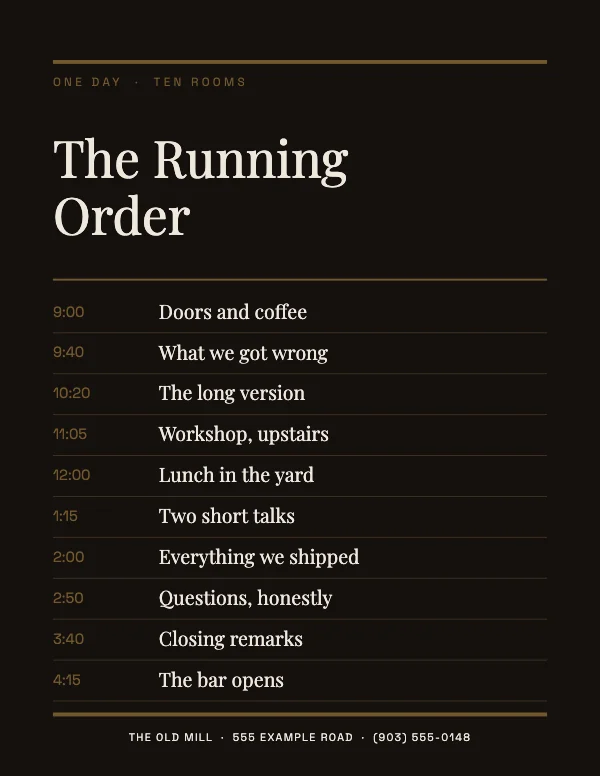
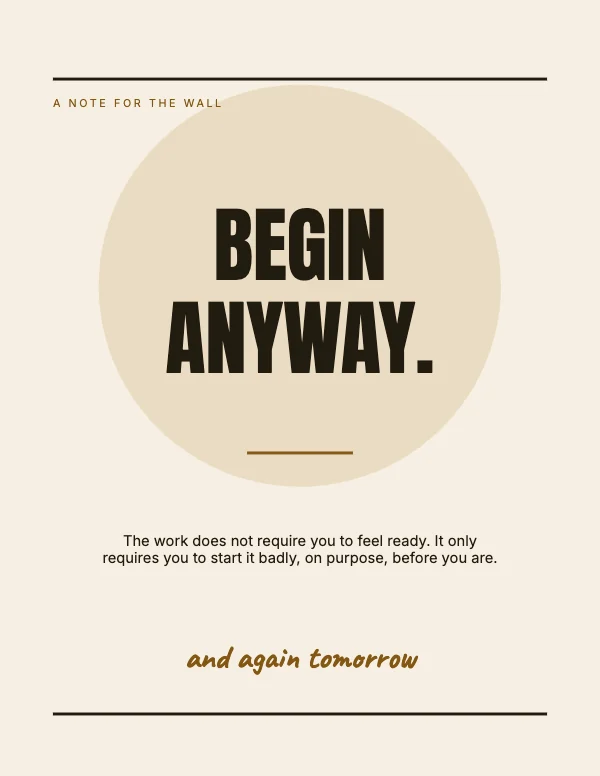
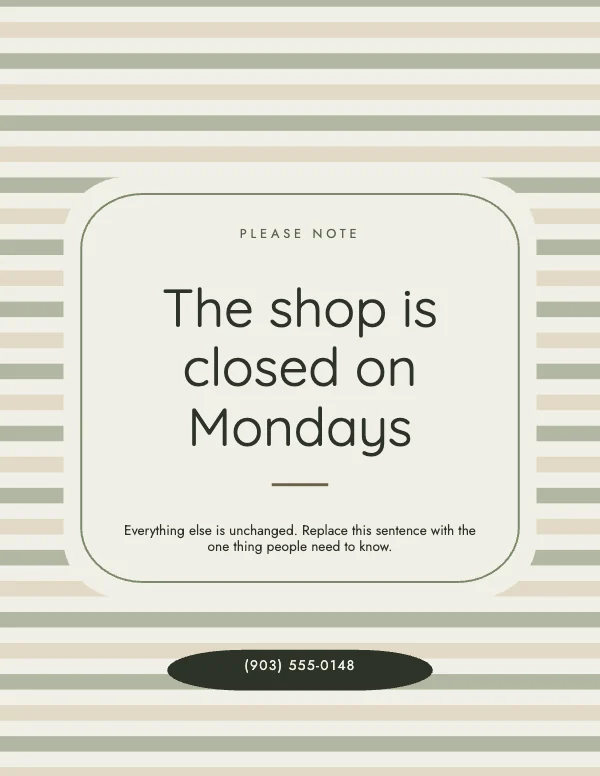
The size that needs no shop
| Trim | 8.5 × 11 in (US letter) |
|---|---|
| With bleed | 8.75 × 11.25 in — only needed for shop printing |
| File at 300 DPI | 2,550 × 3,300 px at trim |
| Text safe area | 0.25 in inside the trim |
| Reads from | arm's length to about 4 feet |
| Home printable | yes, on every printer |
An 8.5 × 11 poster and an 8.5 × 11 flyer are the same object with a different job. The distinction worth keeping: a poster is put up and read from a few feet — one message, large type, one image. A flyer is handed over or taken away, and can carry detail. If yours carries a phone number people are meant to take, you probably want the flyer templates instead.
Print it at home, properly
Three settings account for nearly every bad home print.
Actual size, not fit to page. "Fit to page" or "shrink oversized pages" scales an 8.5 × 11 file down to fit inside the printable area — about 96% — leaving a wider, uneven white border and type slightly smaller than designed. Choose 100% or Actual Size every time.
Export without bleed. A home printer leaves an unprintable margin of roughly 0.17 to 0.25 inch on each side no matter what you do. Bleed is for a blade that is not going to be involved. If you export with bleed, the printer scales or crops it and everything moves.
Borderless, if offered, is not free. It works by enlarging the page two or three percent and letting the excess fall off the edges. On a photograph that is fine. On anything with type near an edge, it is how a phone number loses a digit.
Paper is the cheapest upgrade available here. Plain 20 lb copy paper curls, shows through and looks like a memo. A 32 lb sheet or a light matte photo paper costs a few cents more and changes the object completely.
Use it to proof the big one
This is the most useful thing on this page. Before paying for an 18 × 24 or a 24 × 36, print the same design at 8.5 × 11 on ordinary paper and look at it under real light.
A quarter-size proof catches, reliably: colors that are darker on paper than on screen, a date typo nobody saw on a bright screen, type that is too light to survive ink spread, a photograph that turns out soft, and a layout that is unbalanced in a way that only shows when it is a physical object. It costs one sheet and it has saved more reprints than any other habit in print.
To do it, set the document to 8.5 × 11 in Page Setup and let the layout re-scale, or export the big poster and print it scaled to fit — for a proof, fit-to-page is the one time it is the right setting.
Questions
Can I print an 8.5x11 poster at home?
Yes — that is what the size is for. Print at actual size rather than fit-to-page, export without bleed, and expect a small unprinted margin around the edge that no home printer can avoid.
What is the difference between an 8.5x11 poster and a flyer?
The job, not the size. A poster is put up and read from a few feet — one message, big type. A flyer is handed over and can carry detail and a response mechanism. Both are letter size, and the flyer templates are laid out for the second job.
Do I need bleed on an 8.5x11 poster?
Not for home printing — your printer cannot reach the edge anyway. Only add bleed if a shop is printing it and color runs off the edge, in which case export at 8.75 × 11.25.
Why did my poster print smaller than the page?
Because the print dialog scaled it. "Fit to page" shrinks the file to fit inside the printable area, at about 96% with a wider border. Choose actual size or 100%.
What paper should I use?
Anything heavier than plain copy paper. A 32 lb sheet or a light matte photo paper holds ink better, does not curl, and does not show what is behind it. It is the cheapest improvement available on a home print.
Can I use this to test a bigger poster?
Yes, and you should. Print the design at 8.5 × 11 before paying for an 18 × 24 or a 24 × 36. It catches color shifts, typos and soft photographs for the price of one sheet.
Where to go next
Put together an occasion
Every category
How printing works
Open any of these and it is already the right size. Bleed, margins and trim are set, and there is no watermark on anything you export — on any plan, ever.