
Crevano · Templates · Wedding Templates
Wedding Templates
13 templates for one wedding, built as a suite rather than as twelve separate pieces: the 5 × 7 invitation, the save the date, the RSVP and details enclosures, the ceremony program, both reception menus, the place card, the table number and the folded thank you — plus the two large pieces the whole room reads on the way in, an 18 × 24 seating chart and an 18 × 24 welcome sign. All with 0.125 inch of bleed, and all yours to use commercially.
| Trim sizes | 18 × 24 in · 8.5 × 11 in · 4.25 × 11 in · 5 × 7 in · 4 × 6 in · 4.25 × 5.5 in · 3.5 × 5 in · 3.5 × 4 in |
|---|---|
| Bleed | none · 0.125 in |
| Resolution target | 150 DPI · 200 DPI · 300 DPI |
| Templates | 13 |
| Pages | 14 |
No templates match that.
Wedding templates (13)
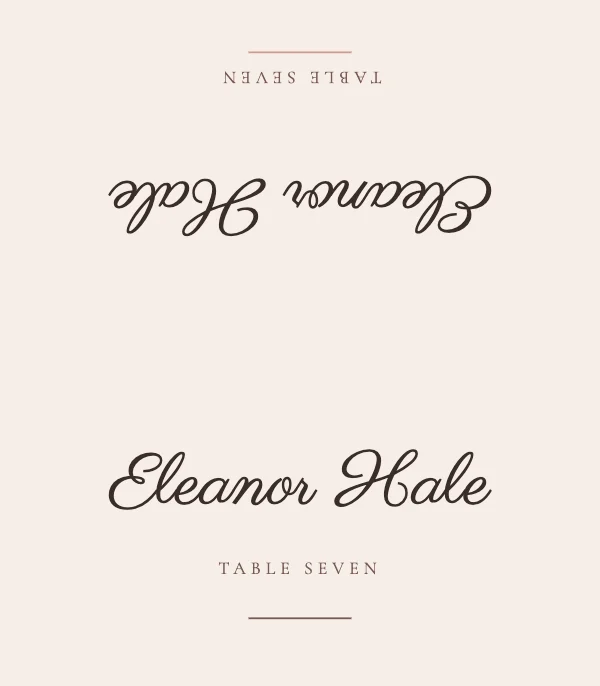 Elegant Folded Tent Place CardPro
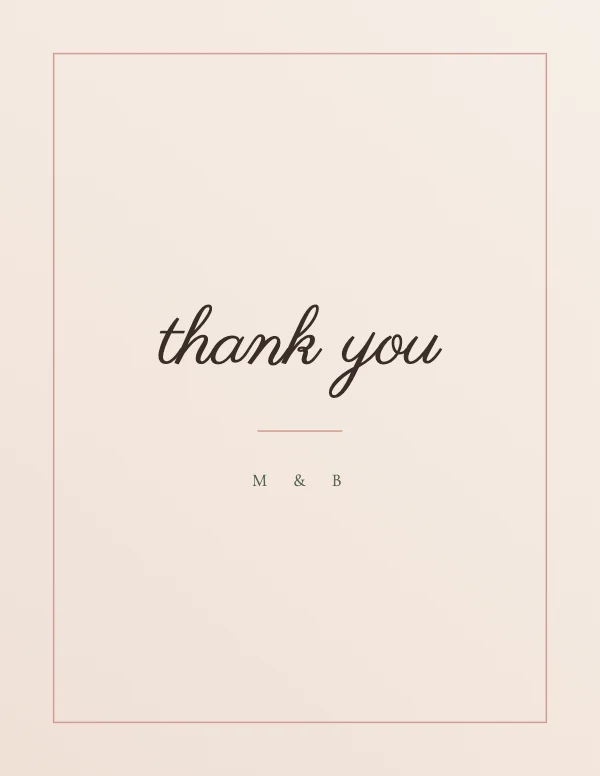 Elegant A2 Folded Wedding Thank You NotePro
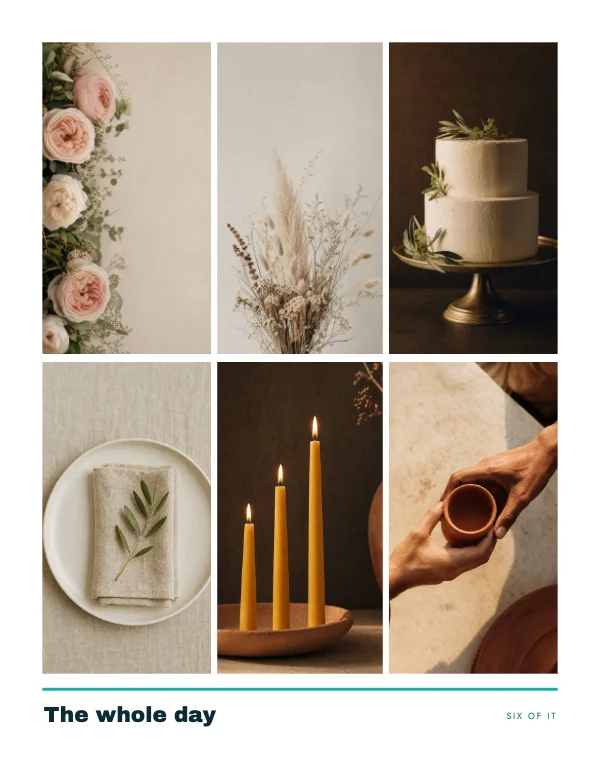 Six Frame Photo Collage SheetPro
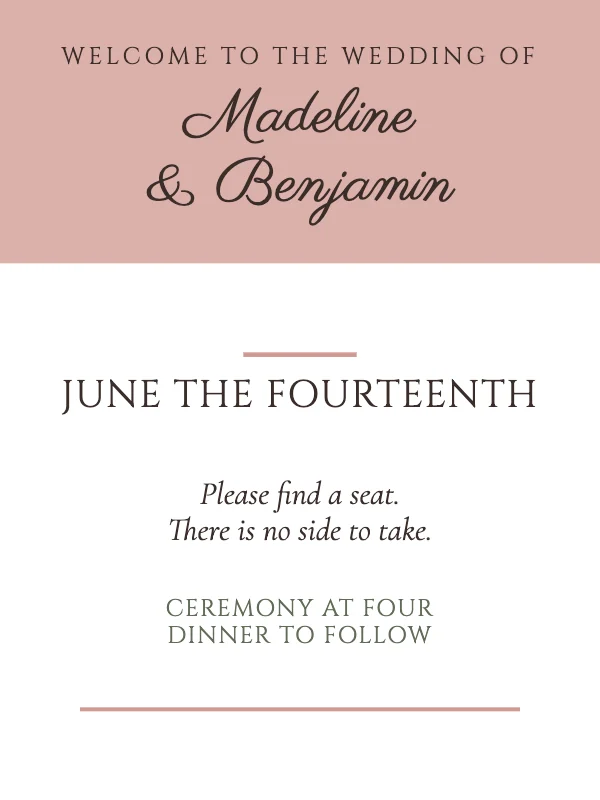 Wedding Welcome Sign
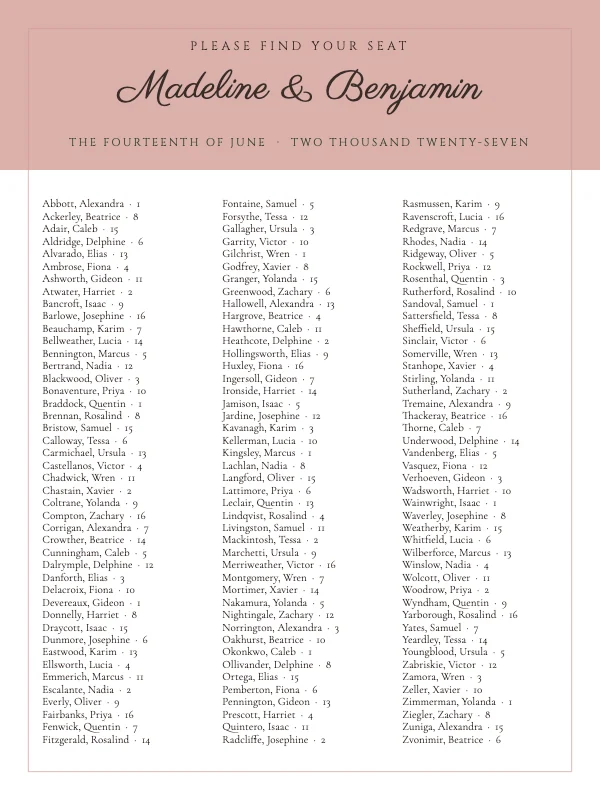 Elegant Wedding Seating ChartPro
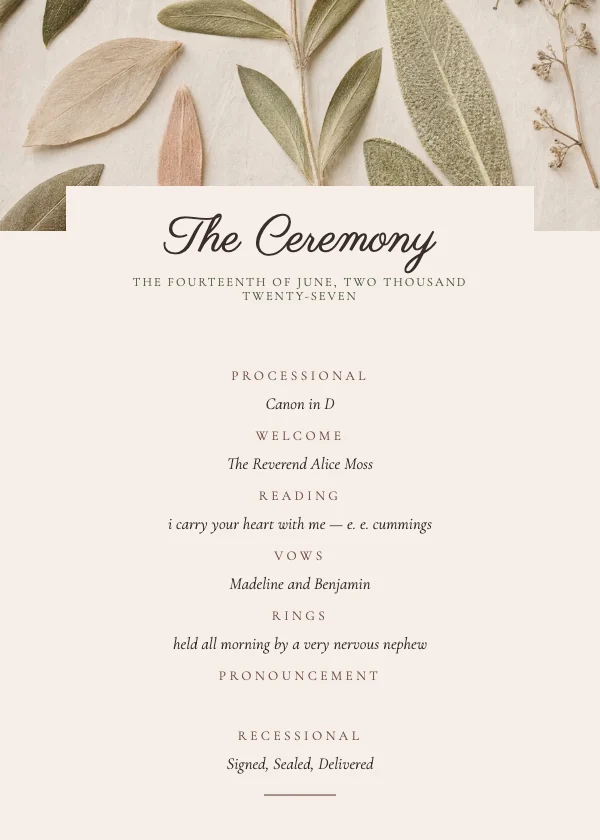 Elegant Wedding Ceremony ProgramPro
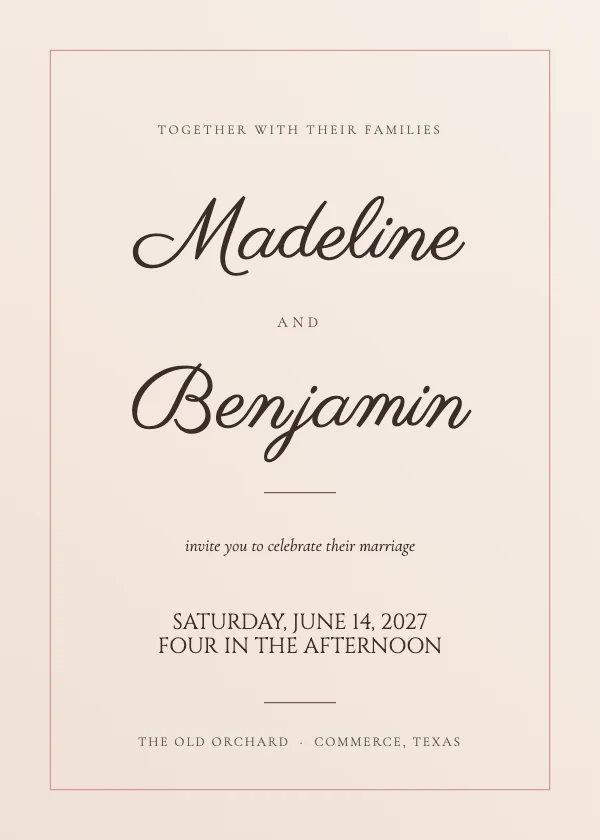 Elegant Wedding InvitationPro
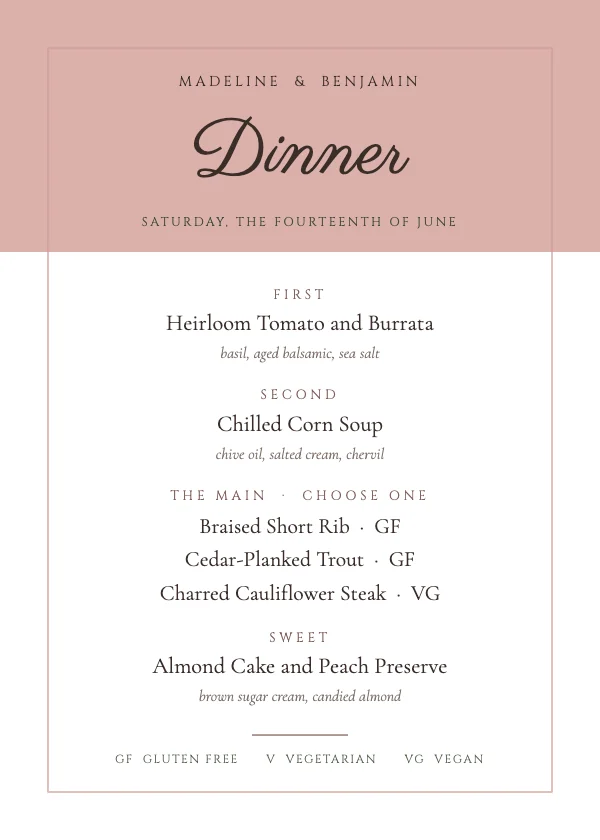 Elegant Wedding Menu Card
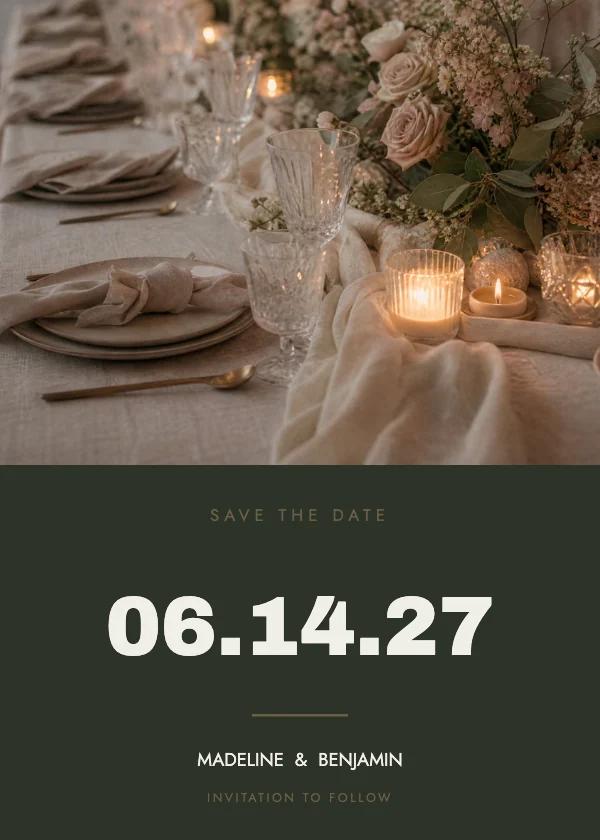 Modern Save the DatePro
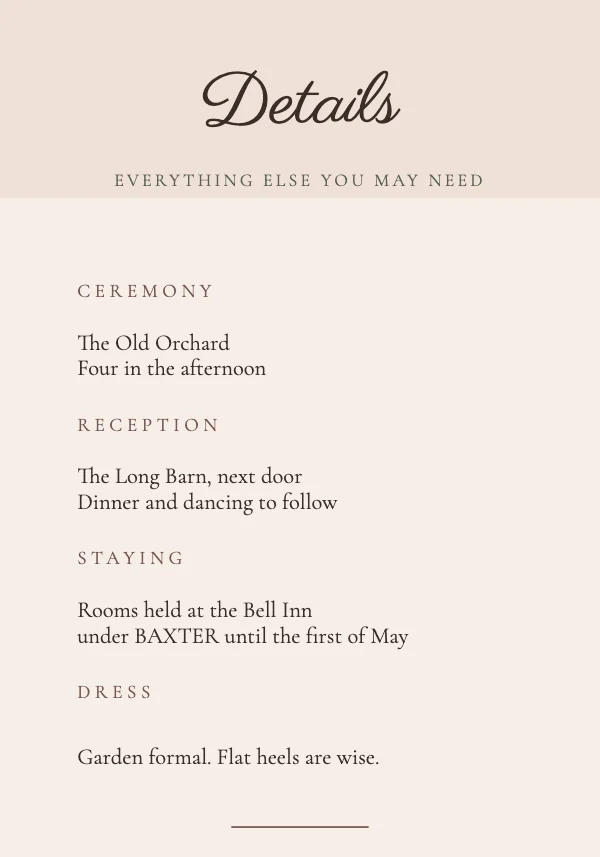 Elegant Wedding Details Enclosure Card
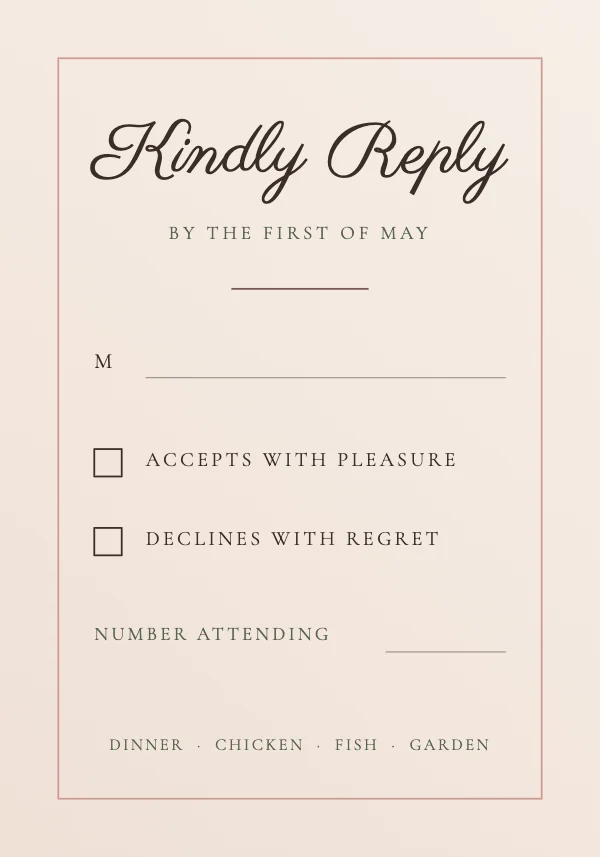 Elegant Wedding RSVP CardPro
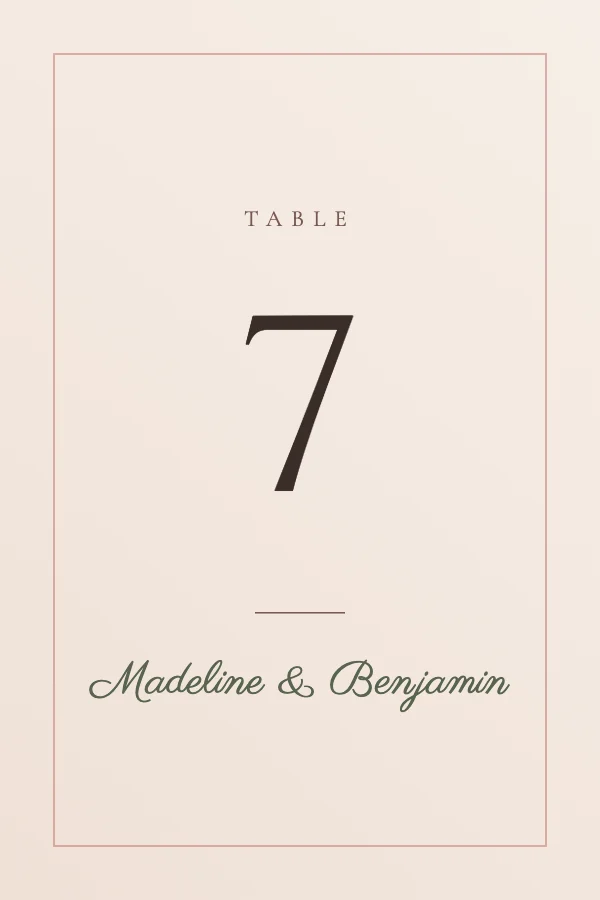 Elegant Wedding Table NumberPro
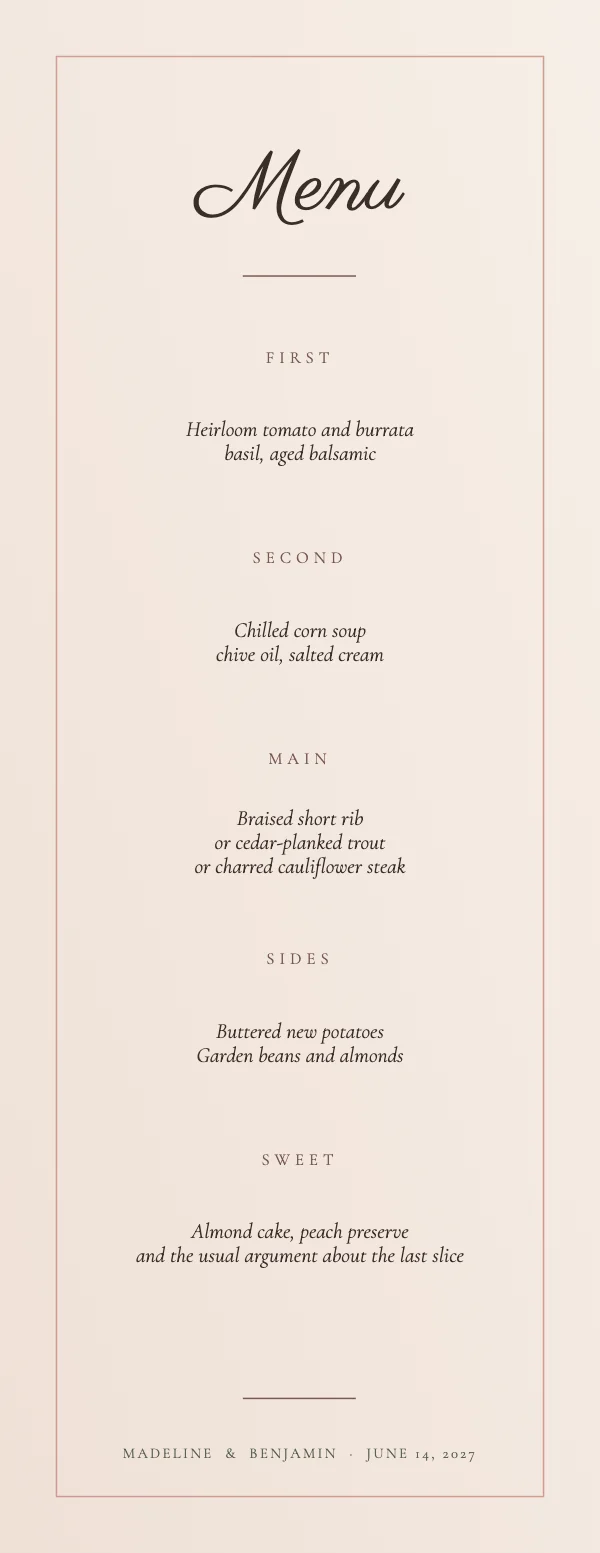 Elegant Tall Wedding Menu CardPro
The mailing set and the day-of set are two different print jobs
This is the thing that catches people, and it is a scheduling problem before it is a design one. The suite splits cleanly in two, and the halves are printed months apart on different stock in different quantities.
The mailing set — save the date, invitation, RSVP card, details enclosure — is printed early, addressed by hand, and stuffed into envelopes. It is counted by household. It has to survive a sorting machine.
The day-of set — ceremony program, menu, place card, table number — is printed in the last fortnight, because it is the only part of the suite that depends on the RSVPs coming back. It is counted by seated guest and by table, and it never goes near a postal service, which means you can use heavier stock, a taller trim and a fold that would never survive the mail.
The practical consequence: do not print the day-of pieces early to save a setup fee. Somebody always cancels in the last two weeks, and a box of place cards with the wrong names on them is worth exactly nothing. The invitation is the piece with a deadline; the place cards are the piece with a headcount.
The count is two different numbers, and only one of them is your guest list
Getting this wrong is the single most common way a couple over-prints the expensive half and under-prints the cheap half.
- Invitations, save the dates, RSVP cards, details cards: one per envelope, not one per guest. A couple gets one. A family gets one. The number you need is the number of addresses on your list, and it is usually a little over half your headcount.
- Programs: one per seat, minus a little. People share, and couples take one between them in practice — but a program is cheap and running out looks worse than a leftover stack.
- Place cards: exactly one per seated adult, spelled the way that person spells it. This is the piece that gets reprinted, and it is reprinted because of names rather than because of counts.
- Menus: one per seat, or one per two seats if they lie between the settings rather than on them. Decide which before you print, because the difference is a factor of two.
- Table numbers: one per table, and print the spares. They are the cheapest item in the suite and the one most likely to be knocked into a water glass.
Add a handful of extras to every mailed piece for addressing mistakes and for the copy you will want to keep. Ten percent is the number most stationers use, and the reason is that hand-addressing an envelope goes wrong more often than printing a card does.
When each piece goes out
Published US etiquette guidance is consistent enough to design to, and it decides when you need the files finished rather than when you need them printed.
| Piece | When it goes | Why |
|---|---|---|
| Save the date | 4–6 months out, or 6–10 for a destination or a holiday weekend | Its only job is to hold the date before anyone books anything else |
| Invitation | 6–8 weeks out — 10–12 if you sent no save the date | Earlier and it gets filed away and forgotten; later and there is no time to reply |
| RSVP deadline printed on the card | 3–4 weeks before the day | It sets the catering count, and it is the date the day-of pieces wait on |
| Programs, menus, place cards, table numbers | printed in the last 1–2 weeks | They depend on the replies, and they cannot be finished before them |
Those are the windows the major US wedding publishers put in print, and they agree with each other closely enough to plan against. A destination wedding, a passport requirement or a holiday weekend pushes every row in the table earlier.
Work backwards from the invitation rather than forwards from today. If the invitation mails eight weeks out and your printer wants ten working days, the artwork is due about eleven weeks before the wedding — which is usually sooner than anyone expects.
One palette, one type pairing, and it is deliberate
One palette and one pair of typefaces run through this suite, used the same way on every piece. That is not a shortcut. A suite is recognizable because it repeats, and the repetition has to be exact enough that a guest who has seen the invitation recognizes the menu on the table three months later without thinking about it.
What repeats, concretely: the same script for the two names, the same small letterspaced capitals for every line of supporting information, the same hairline rule at the same weight, and the same generous margin. The variable is the shape of the piece — 5 × 7 upright, 3.5 × 5 enclosure, 4.25 × 11 tall menu — not the design language on it.
So if you change one thing, change it everywhere. Recoloring the invitation and leaving the place cards on the old accent is how a suite stops looking like a suite, and it is much more visible across a table than it is on a screen.
The save the date is the one deliberate exception. It goes out months before anything else, usually carries a photograph, and nobody has seen the invitation yet — so it is allowed its own palette.
Envelopes, and the one card that is tight
Wedding stationery is sized to envelopes rather than the other way round, and the full table sits on the invitation and card templates page. The three that matter here:
- 5 × 7 invitation → A7 envelope, 5.25 × 7.25 in. A quarter inch of slack on both axes. This is the most-stocked envelope size in the trade and it is why the invitation is 5 × 7.
- 4.25 × 5.5 folded thank you → A2 envelope, 4.375 × 5.75 in. An eighth of an inch on the width and a quarter on the height.
- 3.5 × 5 RSVP card → A1 / 4-bar envelope, 3.625 × 5.125 in — and this one clears by an eighth of an inch in each direction, which is the minimum that works. It goes in. It does not go in quickly, and it will not forgive a card trimmed a hair oversize. If your stationer wants a quarter inch of slack, trim the reply card to 3.5 × 4.875 in, which is the other size 4-bar envelopes are sold against. The template will resize to it without the layout moving.
The details enclosure needs no envelope of its own — it is tucked behind the invitation, which is why it is the same 3.5 × 5 as the reply card rather than a size of its own.
The reading on the ceremony program is not like the verse on it
These are two different permission questions and they have very different answers. It is worth ninety seconds before you print forty of them, because after they are printed there is no fixing it.
A verse has a clean route. The King James Version is public domain and needs nothing. The modern translations — NIV, ESV, NLT, NASB, CSB — are copyrighted, but each publishes its own quotation limits and most simply ask for a credit line on the piece. Read the page once, put the credit in the template, done. The detail is on church templates.
A poem or a song lyric usually has no route at all. Most twentieth-century poetry and essentially all popular music is in copyright with no published quotation allowance — there is no permissions page to read and no credit line that settles it. Permission is negotiated individually, and lyrics in particular are enforced hard. "It is four lines and it is a wedding" is not an exception anybody grants.
So the safe ceremony reading is one of three things: something in the public domain, something written by the couple or the officiant, or something you have written permission to reprint. The first two cost nothing and the third is a letter. A first-dance lyric set in gold on forty programs is the one to think about first, because it is the most common and the least defensible.
Not legal advice, and we are not your lawyer.
Questions
What size is a wedding invitation?
5 × 7 inches, and that is what the invitation and save the date here are built at, because 5 × 7 is the size the A7 envelope is made for and A7 is the most widely stocked envelope in the trade. The enclosures are smaller so they sit behind it: 3.5 × 5 for the RSVP and the details card, 3.5 × 4 folded for a place card, and 4 × 6 for a table number. The menu comes at both of the two sizes the trade actually cuts one at: 4.25 × 11 for the tall card, and 5 × 7 — the invitation's own trim, so the whole suite prints on one stock — for the per-seat card that carries an entrée choice.
How big should the seating chart be, and how many names actually fit?
The honest answer is smaller than the sizing charts imply, because they measure what fits rather than what can be read.
Set the type first. A seating chart is read standing at it from about three feet, and the published floor for type read at that distance is 24 point — go under it and people lean in, which is fine for one guest and a queue for a hundred and thirty. At 24 point the line pitch is 0.373 inch, and an 18 × 24 sheet with a title block holds 44 rows in each of three columns: 132 names. That is the number this chart is built to.
You will see much larger claims — 18 × 24 for "120+ guests" is common, and one seller advertises 325 names on a single chart. Three hundred and twenty-five names in that live area needs about five-point type. It fits. Nobody past the front of the line can read it. Above roughly 130 guests the answer is a bigger sheet, not smaller type.
The seating chart and the welcome sign are not the same kind of sign
They are the same trim, the same palette and the same two faces, and the type on them is set five times apart. That is deliberate and it is the thing to copy if you build your own.
A welcome sign stands on an easel at the door. People stop walking, look at it for two seconds and move on, from about eight feet — so its names are set large and there are perhaps twenty words on the whole sheet.
A seating chart is read from about three feet by somebody looking for one name among a hundred and thirty, while a line forms behind them. It has to be scannable, not impressive.
So the welcome sign carries about 0.8 inches of capital-letter height and the chart carries a quarter of that — because the chart's job is to be finished quickly, and the sign's job is to be noticed. Setting them both at the same size, which is what happens when a suite is designed as a set of files rather than as a set of moments, makes one of them shout and the other one illegible.
Alphabetical or grouped by table?
Alphabetical, once you are past about 80 guests, and it is not close at 130. Grouped by table looks calmer and makes every guest scan every table to find one name; alphabetical is a single pass. Below 80 the argument flips, because at a small wedding people care more about seeing who they are sitting with than about finding themselves quickly.
The names here are set surname first — "Whitfield, Alexandra" — so the sort order is visible in the words. The alternative is "Alexandra Whitfield" under a large letter W, which reads warmer and breaks the moment you paste your own list in, because the letter markers no longer line up with where the letters change. Each column is one text block for the same reason: your guest list is already a spreadsheet, so it should paste in three moves rather than a hundred and thirty-two.
What is bleed and do I need it on a wedding invitation?
Bleed is extra artwork past the trim line — 0.125 inch on every template here — so that when the blade moves a fraction, which it always does, there is still ink where the edge lands instead of a white sliver. You need it whenever color or a photograph runs to the edge of the card. If your design sits on white paper with a margin all round, you do not need it, and printing without it makes cutting by hand at home much more forgiving.
What does 300 DPI actually mean for my engagement photo?
Pixels per printed inch, not a quality setting on a camera. A photograph placed 4.5 inches wide at 300 DPI needs 1,350 pixels across the part you actually use — and a phone photo that has been through a messaging app is often smaller than that by the time it reaches you. Crevano shows the effective resolution at the size you have placed the image and names the axis that ran out. Get the original file from the photographer rather than the copy from the shared album.
Can I print wedding invitations at home?
Some of the suite, yes, and it is worth splitting the job. Place cards, table numbers and menus print and cut well at home. The invitation itself is the piece where stock and a clean cut edge do the most work, and it is the piece every guest handles. Most home printers stop taking card around 65–80 lb cover; heavier than that jams. Print without bleed if you are cutting by eye, and let each sheet dry before you stack it.
What will the print shop ask me for?
A PDF at the trim size with bleed included, and the trim size said out loud rather than guessed from the file. Crevano exports each page as a lossless 300 DPI image inside the PDF, which is good for print and is not the same thing as a vector PDF — so if the shop asks for crop marks or vector type, have that conversation before you send the file rather than after.
Can I print a poem or song lyric on the ceremony program?
Only if it is in the public domain, the couple wrote it, or you hold written permission. Unlike a Bible translation, a poem or a lyric generally publishes no quotation allowance and no credit line that settles it — permission is negotiated case by case, and song lyrics are enforced hard. A verse is the easier case and is covered on church templates. Not legal advice.
Can I use these for a client's wedding?
Yes. Everything here is yours to use commercially, including on the free plan, with no watermark, no royalty and no credit required, and the permission does not expire. That covers your own wedding, a wedding you are planning for somebody else, and stationery you sell.
How many invitations do I need for 120 guests?
Fewer than you think, because an invitation is addressed to a household rather than to a person. A 120-guest list is usually somewhere around 60 to 70 envelopes once couples and families are counted once each. Count the addresses on your list, not the names, and add about ten percent for hand-addressing mistakes and for the one you keep.
When should the invitations go out?
Six to eight weeks before the wedding for a local one, ten to twelve if you did not send a save the date, and about three months for a destination wedding. Print the RSVP deadline on the reply card for three to four weeks before the day. Save the dates go much earlier — four to six months, or six to ten for a destination or a holiday weekend.
Do the place cards and menus have to match the invitation?
They have to look like they came from the same wedding, which is not the same thing as identical. One palette and one type pairing run through the suite on purpose, and the repetition is what makes a suite read as a suite across a table. The save the date is the exception — it goes out months earlier, usually with a photograph, and nobody has seen the invitation yet.
Where to go next
Put together an occasion
Every category
How printing works
Open any of these and it is already the right size. Bleed, margins and trim are set, and there is no watermark on anything you export — on any plan, ever.