
Crevano · Templates · Printable Party Decorations
Printable Party Decorations
6 sheets you print on your own cardstock and cut out by hand — cake toppers on skewers, a pennant banner on twine, favor tags on a punch, folded table tents, photo booth props on a straw and advice cards for a jar.
This is the only part of the library the buyer finishes with scissors, and the whole set is built around that: no bleed anywhere, and every cut line drawn 1/16 inch outside the ink it belongs to, so a hand cut that wanders lands in white paper instead of biting the design.
| Trim size | 8.5 × 11 in |
|---|---|
| Bleed | none |
| Resolution target | 300 DPI |
| Templates | 6 |
| Pages | 6 |
No templates match that.
Printable party decorations (6)
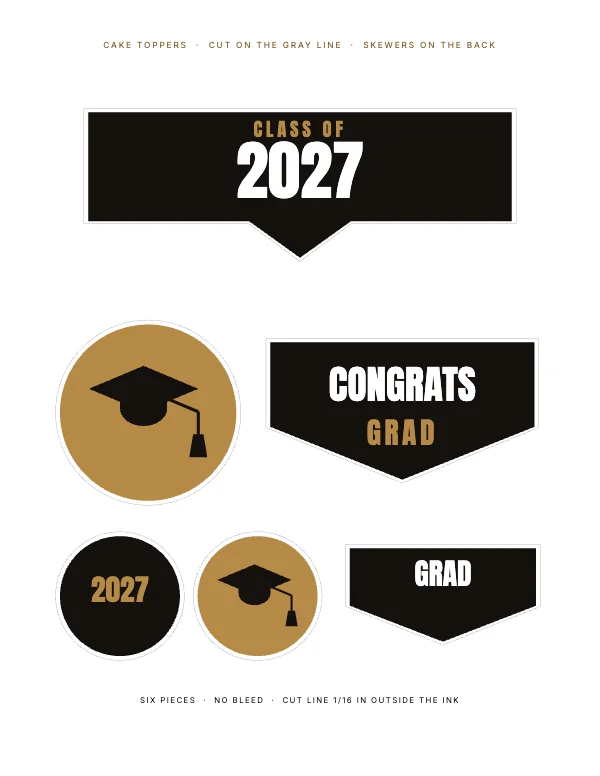 Graduation Cake Topper Sheet
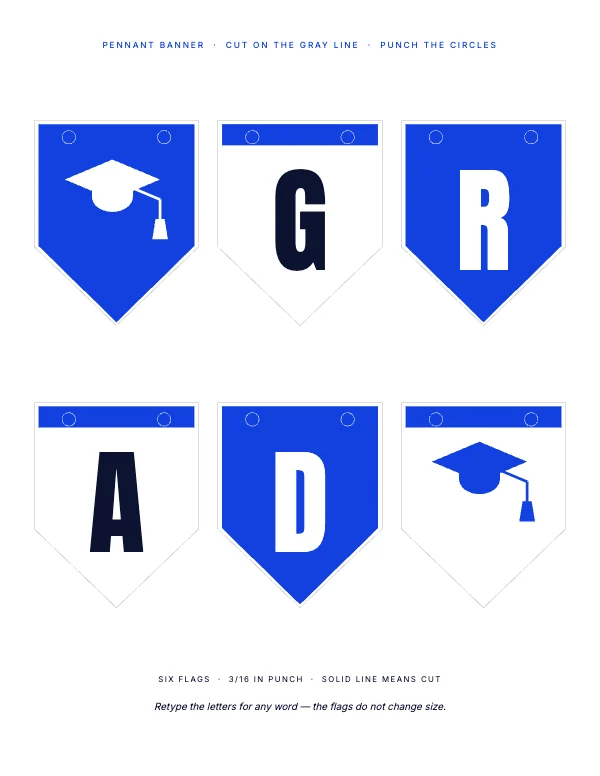 Graduation Pennant Banner Sheet
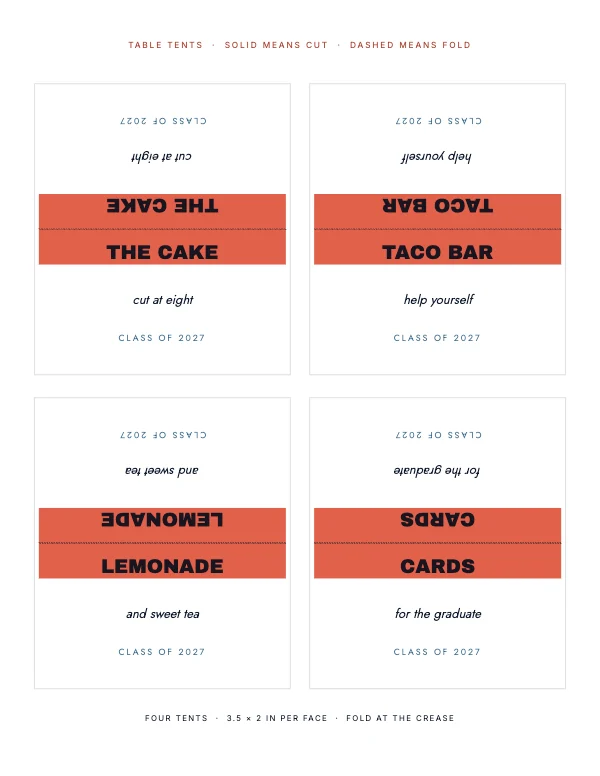 Graduation Table Tent SheetPro
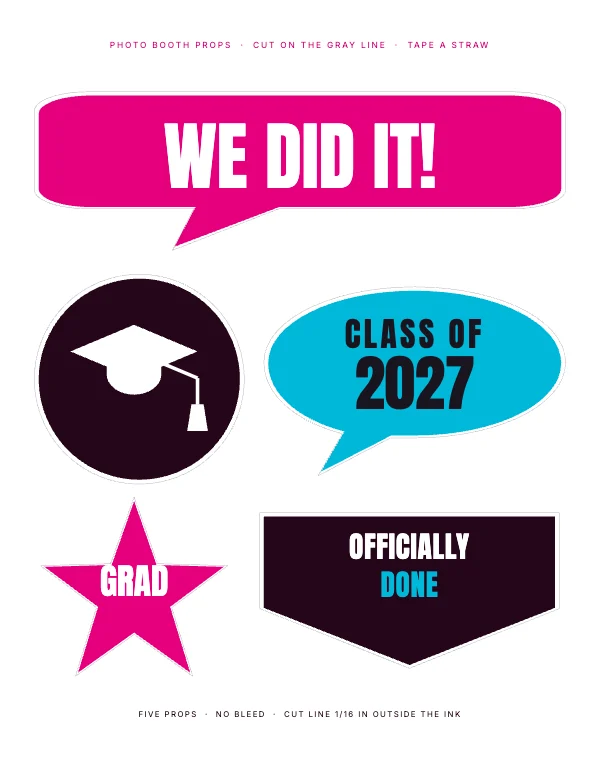 Graduation Photo Booth Prop SheetPro
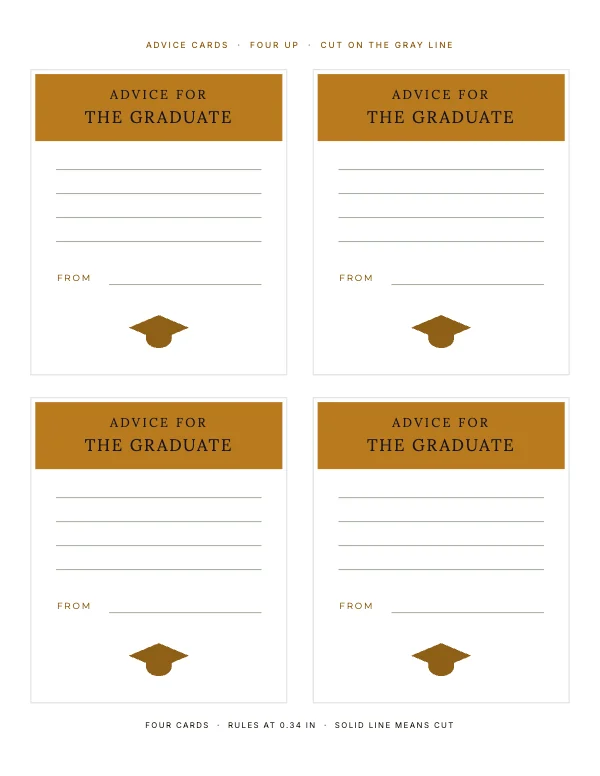 Graduation Advice Card Sheet
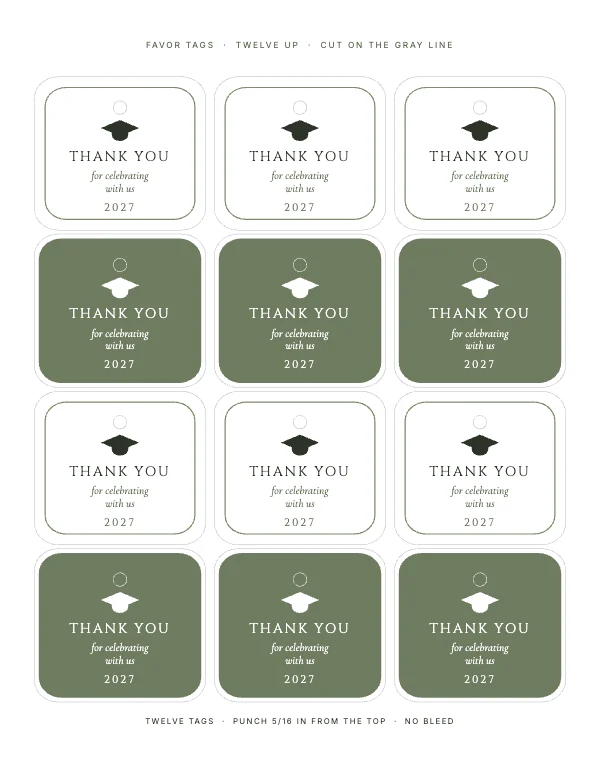 Graduation Favor Tag Sheet
No bleed, and that is not an omission
Every other print category on this site carries 0.125 inch of bleed, and this one carries none.
Bleed exists for a blade. A commercial printer prints oversized and trims, and the bleed gives the blade somewhere to be wrong. Neither of those happens here. A consumer inkjet cannot print to the edge of a plain sheet at all — it holds an unprintable margin on every side — and the cutting is done by a person with scissors, not by a machine with a registered blade.
Put bleed on a sheet destined for a home printer and the driver scales or crops the page to fit its own margin. Everything shifts, and the cut lines shift with it, which is worse than useless because they were the one thing you were trusting.
Built with no bleed, the sheet you print is the sheet that was designed.
Solid means cut. Dashed means fold.
One rule across every sheet, and the sheets print it on themselves: cut on the gray line.
The cut line is a solid light-gray outline, deliberately not one of the ink colors in the artwork, so there is never a question about which line is an instruction and which is part of the design. Every sheet has these; they are the only lines on five of the six.
The table tent sheet is the only one that folds, and its fold is a dashed dark rule across the middle of each tent. Solid and gray is a cut, dashed and dark is a fold — two differences, not one, so the two cannot be confused at arm's length with scissors in your hand.
The important detail is where the cut line sits: outside the ink, by exactly 1/16 inch, never on it. That is the difference between a hand-cut piece that looks made and one that looks homemade. Cut on a line drawn over the artwork and every wobble takes a bite out of the design; cut on a line drawn beside it and a wobble is invisible, because it happens in white paper.
The punch marks are drawn the same way. Favor tags carry a mark 5/16 inch inside the top edge and pennants 3/8 inch inside theirs, with all type set clear of it, so a hole punch never lands on a letter.
Use the heaviest stock your printer takes
65 lb cardstock or above. This matters more here than anywhere else in the library, because these pieces are held up: a topper on a skewer, a prop on a straw, a pennant on twine. Regular paper curls, and a curled cake topper is visible in every photograph taken that afternoon.
Table tents and favor tags get handled all evening by people who are not being careful, which is the same argument.
Feed cardstock one sheet at a time and use the rear or straight-through tray if your printer has one — a heavy sheet through a curved path comes out bowed.
The occasion is a text element
These are party sheets first, and whatever the occasion says on them second. Every line of type is editable, so the same six layouts serve a graduation, a birthday, a retirement or a baby shower — retype the words and reprint.
That is deliberate, and it is why they are filed by method rather than by occasion. A set built only for one party would need building again for the next one, on identical geometry.
One thing worth saying about the words: the phrases people most want on party decorations are often lines from books, songs and films, and those belong to somebody else. These ship with plain wording — a name, a year, congratulations — so what comes out of your printer is yours to use and to sell. If you replace it with a quotation, that permission is yours to hold.
Questions
What size are these sheets?
All 8.5 × 11 inches at 300 DPI with no bleed — US Letter, for a home or office printer, on your own cardstock.
Why is there no bleed?
Because nothing trims these but you. A consumer printer cannot reach the edge of a plain sheet, and adding bleed makes the driver scale the page, which moves the cut lines you were relying on.
Which line do I cut?
The solid gray one, and the sheets print that instruction on themselves. The table tent sheet also carries a dashed dark rule across each tent — that one is a fold, not a cut. No other sheet folds.
Should I cut on the line or outside it?
On it. The line is drawn exactly 1/16 inch outside the ink, so cutting on the line leaves a thin clean edge and cutting a little wide still looks deliberate.
What paper should I use?
Cardstock, 65 lb or heavier, fed one sheet at a time. These pieces get held up and handled, and regular paper curls.
Can I use a cutting machine instead of scissors?
You can cut them by hand or with a trimmer. The cut lines are printed artwork rather than a machine cut file, so a Cricut or similar will not read them automatically — the label and sticker templates are the ones with die lines drawn as real elements.
Can I change these for a birthday or a retirement?
Yes, and that is the point. Every word is a text element; the geometry does not care what the occasion is.
Can I sell what I make from these?
Yes, including finished decorations at a market or on Etsy. No royalty, no credit, and the permission does not expire. That is true on the free plan as well as the paid one. What you may not do is resell our artwork as files in themselves.
Where to go next
Put together an occasion
Every category
How printing works
Open any of these and it is already the right size. Bleed, margins and trim are set, and there is no watermark on anything you export — on any plan, ever.