
Crevano · Templates · Yard Signs · Open House Sign Templates
Open House Sign Templates
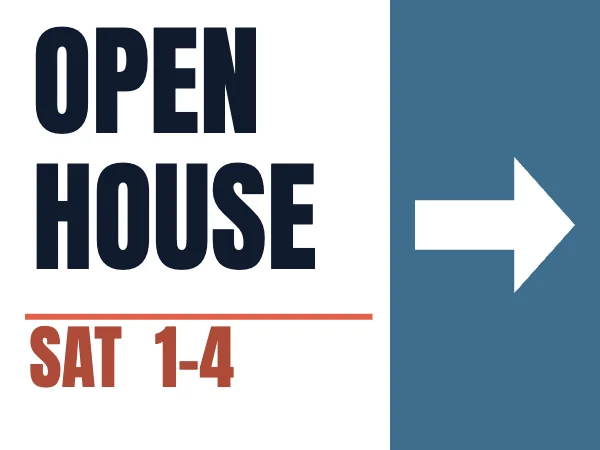
A 24 × 18 in directional sign for the corner two streets away, built to the one number that decides whether it works: the headline is set at 4.2 inches of cap height, which is what the sign trade's own rule gives for a 35-foot read from a moving car.
No templates match that.
The arrow is the sign
A directional open-house sign is not an advertisement. It has one job — turn a car — and it is read in about two seconds by somebody who is driving and not looking for you.
That gives you three elements and no more: the words OPEN HOUSE, an arrow, and a time or an address if there is room. Everything else you are tempted to add — the brokerage logo, your photograph, the price, a QR code — is invisible at 35 feet and is taking size away from the two things that are not.
The one exception worth making is a phone number, and only on the sign that stands at the property rather than on the corner, because that one is read by somebody who has already stopped.
Where the 4.2 inches comes from
The sign trade's rule is one inch of cap height for every ten feet of viewing distance. At 35 feet that is 3.5 inches, and the trade adds about 20 percent beside moving traffic because a driver gets one glance rather than a stare. 3.5 × 1.2 ≈ 4.2 inches.
That is why this template will not let the headline shrink below it. On a 24-inch-wide sign, 4.2 inches of cap height is most of the height of the sign — which is exactly the point, and it is why a real yard sign carries two or three words and a supermarket flyer carries thirty.
Print it, stake it
24 × 18 in landscape on 4 mm corrugated plastic — coroplast — is the standard, and it is what every sign shop quotes against. It takes an H-stake through the flutes, which is why the orientation matters: the flutes must run vertically for the stake to grip, and a shop will ask you which way. For a 24 × 18 landscape sign the answer is across the short dimension.
The file is built at 150 DPI at final size with 0.125 in of bleed. 150 is not a compromise: it is the large-format standard, because a sign read at 35 feet resolves nothing a poster held at arm's length would. A 24 × 18 at a true 300 DPI would be a 7,200 × 5,400 file that no one can tell from this one.
Order double-sided if the sign sits on a corner. A car approaching from the other direction sees a blank white rectangle otherwise, and the second side costs far less than the first.
Before you stake it
Sign placement on public land — verges, medians, utility poles, roundabouts — is governed by local rules that differ by city and sometimes by subdivision, and signs get removed. Ask your brokerage or your city's code office what applies where you are putting them. It is a five-minute question that saves a Saturday's worth of signs.
Questions
What size is an open house sign?
24 × 18 inches landscape is the standard yard-sign size and what this template is built at. 18 × 24 portrait is the same board turned, used more often for a sign at the property than for a directional one on a corner.
How big does the text need to be?
One inch of cap height per ten feet of viewing distance, plus about 20 percent beside moving traffic. For a corner sign read at 35 feet that is 4.2 inches. The template holds the headline there and will not go smaller.
Should I put my photo or logo on it?
Not on a directional sign. At 35 feet neither is legible, and both take size from the arrow and the words. Save them for the flyer in the box at the property.
What material do I print on?
4 mm corrugated plastic, called coroplast, with an H-stake. Any sign shop stocks it. Paper and foam board do not survive one night of weather.
Why 150 DPI and not 300?
Because 150 is the large-format standard and 35 feet cannot resolve more. A 300 DPI file of this size is four times the pixels and looks identical staked in a lawn.
Can I use these commercially?
Yes, including as an agent or a brokerage. No royalty, no credit, and the permission does not expire. That is true on the free plan as well as the paid one.
Where to go next
Other sizes
Put together an occasion
Every category
How printing works
Open any of these and it is already the right size. Bleed, margins and trim are set, and there is no watermark on anything you export — on any plan, ever.